
One of the things I cherish the most in my work at CSNTM is the opportunity to see New Testament manuscripts, both in person and on our website. After all, these are the books that transmitted and preserved the sacred text that tells us about the life and works of Jesus Christ and the teachings of his apostles. Besides the biblical text, these manuscripts often provide glimpses into captivating traditions of the Church (also, you never know what interesting things you will find in them!).
The other day while I was working with some images of manuscripts, I came across a fascinating New Testament commentary.
This particular manuscript, also known as GA 1934, has all the epistles of Paul. Also, it is beautifully illuminated—it has full-page images with gold background and detailed frames, as well as intricate headpieces at the beginning of each biblical book.
A commentary manuscript is what the name implies: it is a book that contains biblical text with comments from the Church Fathers, men like Origen, Athanasius, and Cyril of Alexandria.
What immediately caught my eye was the rich decoration at the very beginning of the codex before the Pauline corpus. You might look at these pages and ask: “Who are these guys and what are they saying? This looks more like a comic book to me!”
Let me tell you that these are important people (otherwise, they would not be painted on a New Testament manuscript, right?).
But they are not saying anything
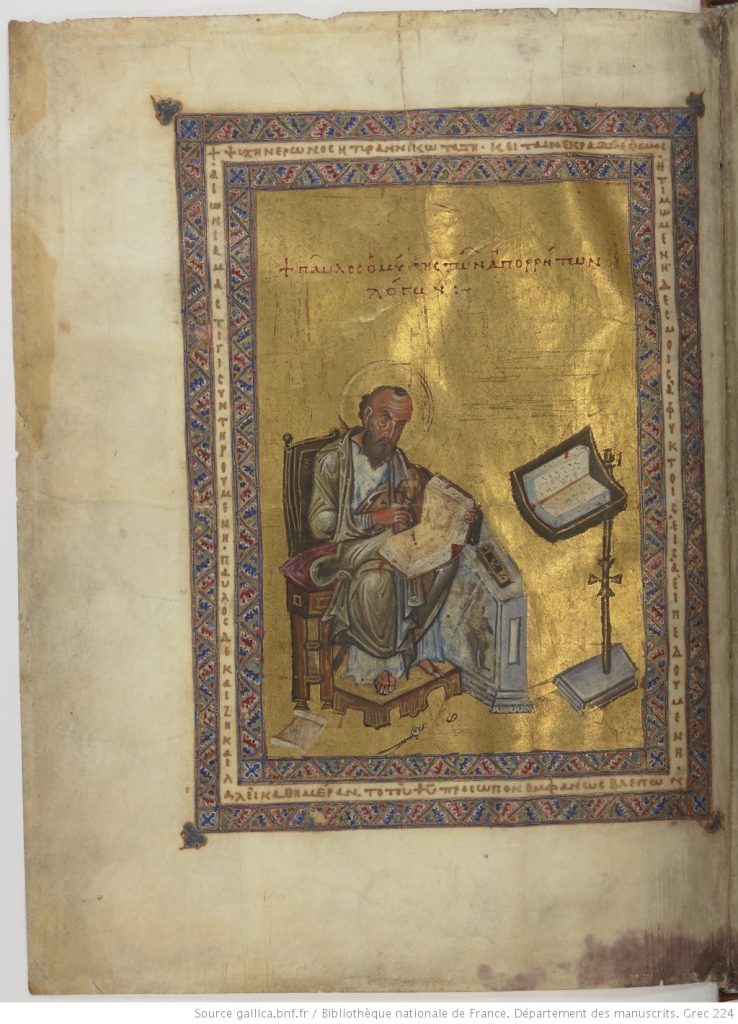
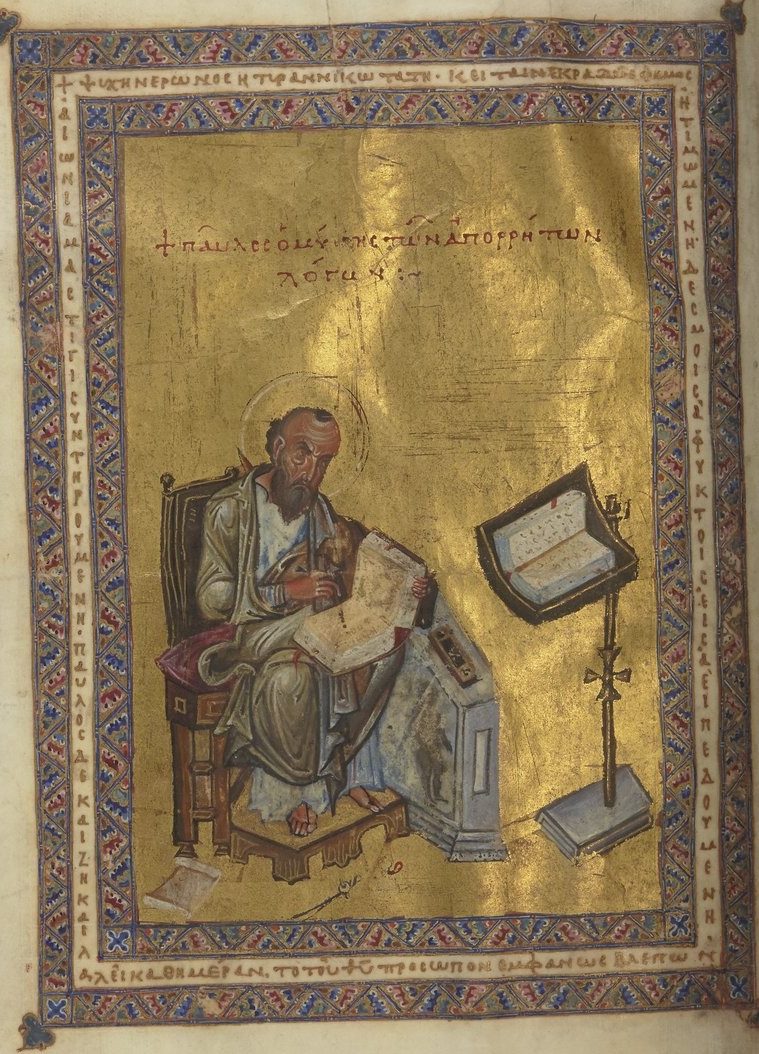
On the left side, you have the apostle Paul depicted sitting on a chair and writing something down on a book (and he’s really focused on the task, as you can tell by his facial expression!). According to the inscription in red ink above, that “something” is the Pauline epistles. The inscription presents Paul as the one who has direct access to the ineffable words of God. Paul is receiving revelation directly from God.
If the apostle Paul is on the left, then who is the guy who appears to be standing in a cathedral chair in the middle of the page on the right?
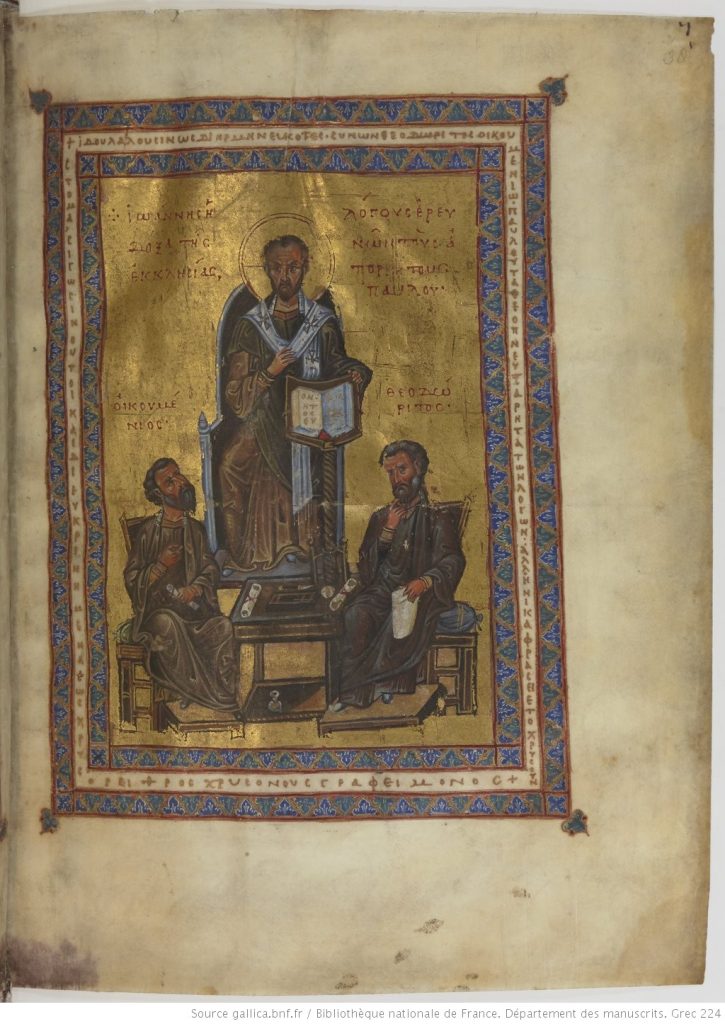
You may have heard of him. That is John Chrysostom, or “John the Golden Mouth,” a prominent Church Father who was active especially in the second half of the fourth century. And Chrysostom is behind an open book that faces the reader. That open book is the Pauline Corpus.
How do I know that?
Simply because the Church regarded Chrysostom as the mouthpiece or interpreter of Paul par excellence. And, of course, he was an excellent rhetorician. Thus, Chrysostom was ascribed the honorific title you read on this page written in red ink: he is called “John, the glory of the Church,” and portrayed as the one “interpreting the ineffable words of Paul.”
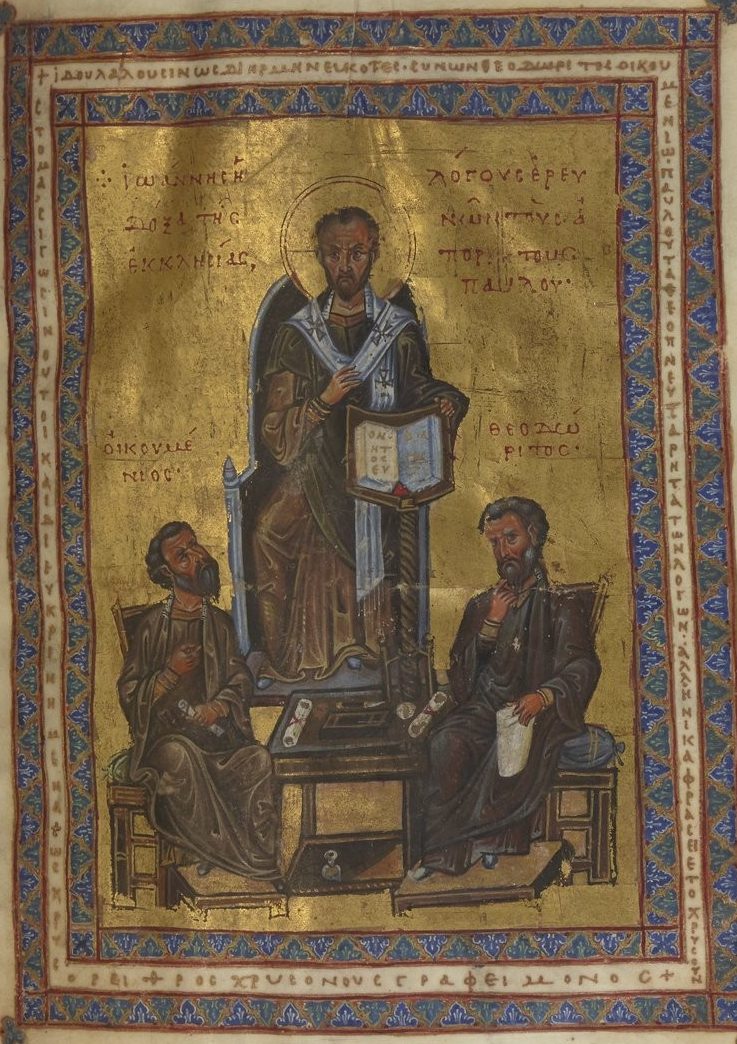
Just as the apostle Paul received the ineffable words of God, Chrysostom interprets the ineffable words of Paul. That’s why—if you look carefully you will notice—he’s intently looking at Paul, perhaps with some exasperation—and almost contempt—as he tries so hard to understand what the divine apostle is saying!
But that’s not all.
There are two men sitting at Chrysostom’s feet: the one on the left seems perplexed with what he hears but is eager for more; the one on the right is scratching his beard, deep in his thoughts, perhaps lost in the theological complexities of Paul and Chrysostom’s interpretation.
Who are they?
They are two Church Fathers. Their names are written above their heads in red: the one on the left is Oecumenius and the other is Theodoret. Why are they sitting? Well, when you are sitting at someone’s feet, that means you are learning from that person. These two Church Fathers are learning from Chrysostom. The one doing the teaching is Chrysostom.
Interestingly, if you flip the pages of this manuscript, you will see the names of Oecumenius and Theodoret next to the marginal commentaries on the biblical text. This means they are relaying to the reader the interpretation of the text. However, as communicated by this picture at the beginning of the manuscript even before the biblical content and the associated commentary, the interpretation is ultimately that of Chrysostom. Chrysostom is the trumpet thunder, to whom Paul whispered his words and who proclaims them across seas and lands (see GA 1933).
Or as we read in another manuscript: as soon as John the Golden Mouth speaks, Oecumenius and Theodoret remain silent.
Manuscripts are awesome, aren’t they?
More than the sacred text, New Testament manuscripts represent a window into how Christians from centuries past utilized these documents. And in the case of GA 1934, the illuminations illustrate the principle that the task of biblical interpretation was assigned to a few individuals who operated within specific theological boundaries to protect the Christian community from heresies.

Denis L. Salgado
CSNTM Lead Research Fellow & Assistant Executive Director