
Whether or not you self-identify as an “organized person,” every human uses organized systems to navigate life. Most stores arrange products by type, brand, use, or another relationship. Traffic lawsContinue reading Manuscripts 101: GA Numbers
Whether or not you self-identify as an “organized person,” every human uses organized systems to navigate life. Most stores arrange products by type, brand, use, or another relationship. Traffic lawsContinue reading Manuscripts 101: GA Numbers →
Some of the missing content was supplemented in the fifteenth-century. Possibly of Alexandrian origin, Codex Vaticanus belonged to the famous Cardinal Basilius Bessarion (1400–1472), Latin Patriarch of Constantinople. Shortly after Bessarion’s death, the manuscript appears in the catalog of the Vatican Library in 1475. In 1797, it was taken to Paris, then returned to the Vatican after Napoleon’s fall in 1815.
Another influential scholar was Johann Jakob Wettstein (1693–1754). He began to organize the evidence of the Greek manuscripts and developed numerous guidelines to help scholars decide which reading is the original. One of his principles was that the Textus Receptus should have no authority. However, he still printed the Textus Receptus in his edition of the Greek New Testament published in 1751–1752. The influence of Wettstein on the discipline was diminished because he was accused of promoting heretical views that denied the deity of Jesus Christ.
Throughout the eighteenth and nineteenth centuries, scholars continued to refine the discipline of New Testament Textual Criticism. Most of them, convinced that the Received Text was inadequate, sought to recover the original text of the New Testament. After many attempts to dethrone the Received Text, scholars B.F. Wescott (1825–1901) and F.J.A. Hort (1828–1892) published their edition of the Greek New Testament in 1881. This edition constitutes a turning point in the belief that the Received Text represents the original text.
In the following decade, Eberhard Nestle (1851–1913) published his first edition of the Greek New Testament. This is the beginning of today’s Nestle-Aland Greek New Testament (NA). Upon Nestle’s death, the publication was handed over to his son, Erwin Nestle (1883–1972). The edition is known as “Nestle-Aland” because in 1952, it was produced in cooperation with Kurt Aland (1915–1994). This is the standard edition of the Greek New Testament used by scholars, Bible translators, seminary professors, and pastors who interact with the New Testament in Greek. Currently, the Nestle-Aland text is in its twenty-eighth edition (NA28).
Besides editing the edition, Kurt Aland also founded in 1959 the Institute for New Testament Textual Research (INTF) in Münster, Germany. One of the initial tasks of the institute was to create microfilms of numerous manuscripts. INTF also carries out ongoing research into the Greek New Testament, maintains the official catalog of New Testament Greek manuscripts, and edits and publishes the standard critical editions of the Greek New Testament.
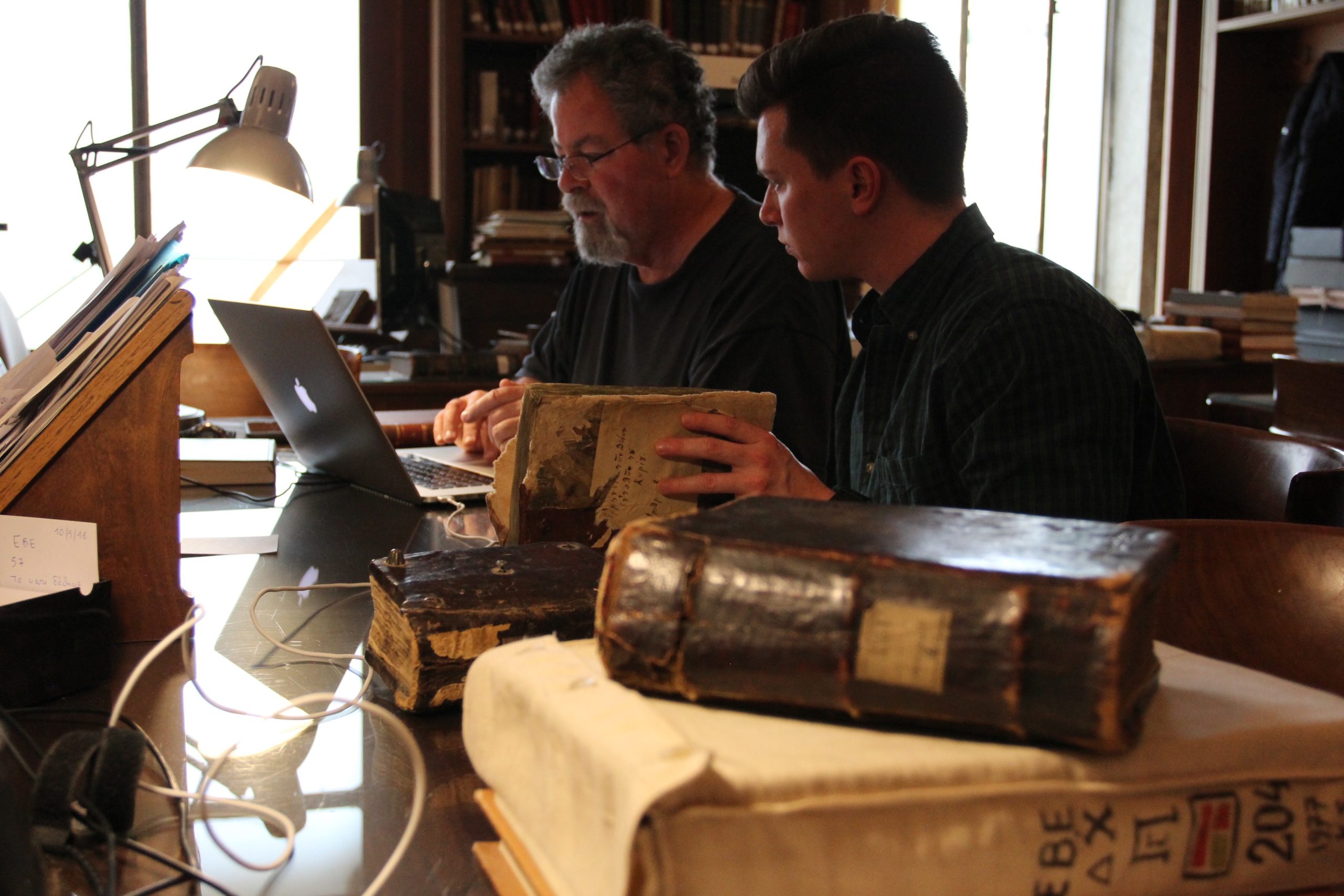
In 2002, Daniel B. Wallace founds the Center for the Study of New Testament Manuscripts (CSNTM) to digitize all surviving Greek manuscripts of the New Testament. The microfilm images are helpful, but many times they are unclear. For this reason, CSNTM has been producing high-resolution photographs of these documents. Since 2002, the team has visited hundreds of institutions in more than 50 countries, digitally preserving their manuscripts. They have also discovered almost 60 previously unknown manuscripts that can now be found in the official catalog. Images are available online on the Digital Manuscript Collection website. Scholars visit the website to study manuscript images as they edit the text that stands behind English translations of the New Testament. Through this work, CSNTM helps ensure that readers of the New Testament today hold in their hands the most accurate text possible.
Since other publishers in Italy and Spain were producing similar editions, Froben pressured Erasmus to conclude the project in record time. Thus, in 1516, the first edition of the Greek New Testament was published. Unfortunately, however, because of the pressure from the publisher Froben, the text of this first edition was especially deficient: Erasmus was able to use only eight manuscripts available to him in Basel, and all manuscripts were late—most dated to the twelfth and fifteenth century.
It was in this first edition that Erasmus famously left out from the Greek the Trinitarian Formula in 1 John 5:7–8. He argued that the Formula was absent from the Greek manuscripts he consulted, even though it was present in the Latin Vulgate, the version authorized by the Roman Catholic Church.
As expected, Erasmus produced other editions of the Greek New Testament (1519, 1522, 1527, 1535), making few changes to the text. In his third edition, he added the Trinitarian Formula back in the Greek text because someone introduced him to a Greek manuscript that had the Formula. This manuscript was produced around 1510 and 1520 by a scribe named Roy. Some believe the document was crafted to provide Erasmus precisely with the missing Greek evidence for the Formula. The editions of Erasmus circulated widely and thus became the standard text of the Greek New Testament.
Other editions of the Greek New Testament appeared in the sixteenth century. In 1524, Wolfius Cephaleus edited a Greek New Testament. The most significant aspect of this edition is that Wolfius removed the Trinitarian Formula from the Greek text. By doing so, he contradicted the edition Erasmus produced in 1522.
In the middle of the century, Robert Estienne or Stephanus (1503–1559), son of a Parisian publisher, produced four editions of the Greek New Testament: 1546, 1549, 1550, and 1551. The text printed in these editions rarely deviates from the text edited by Erasmus. However, Stephanus added some innovations. The main one appears in the fourth edition: for the first time, verse numbers accompany the biblical text.
In the first half of the 1600s, the Dutch brothers Bonaventure (1583–1652) and Abraham (1592–1652) Elzevir continued the legacy of Erasmus. They produced three editions of the Greek New Testament: 1624, 1633, and 1641. Like Stephanus, the Elzevirs printed the text of Erasmus. This time, however, the text acquires an elevated status because the Elzevirs write in the preface to the 1633 edition that they are presenting to the reader “the text received by all.” For the first time, therefore, the text of Erasmus becomes known as the Textus Receptus or the Received Text (a.k.a. TR).
Several editions of the Greek New Testament appeared from 1516 to 1641. Nonetheless, the text being perpetuated was the same one Erasmus produced based on eight late manuscripts. And from now on, this unsatisfactory text is perpetuated with the canonized status of Received Text.
Arguments have been advanced to support the theory that Sinaiticus was produced in Caesarea, then taken to St. Catherine’s Monastery in Sinai, Egypt, in the sixth century, when the monastery was founded under Byzantine Emperor Justinian I. The codex remained at St. Catherine’s Monastery until the mid-nineteenth century, when Constantin von Tischendorf managed to arrange the donation of the codex to the library in St. Petersburg, Russia. Then in 1933, Codex Sinaiticus was sold to the British Library for £100,000.
has eighteen leaves with text from 1 Peter 1:1–5:14, and 2 Peter 1:1–3:18. Another part is housed at the Martin Bodmer Foundation and has four leaves with the epistle of Jude. Before being separated, the two parts were bound with other papyrus gatherings in one codex known as the “Composite” or “Miscellaneous” codex. Besides the New Testament content, this “Miscellaneous Codex” contained various non-canonical documents, such as the Protoevangelium of James, the pseudo-Pauline letter of 3 Corinthians, the 11th Ode of Solomon, Peri Pascha by Melito of Sardis, and a hymn. The document was part of a finding of papyrus manuscripts in the 1950s in the proximity of Dishna between Nag Hammadi and Dendera, Egypt.
one leaf is housed at the Chester Beatty Museum in Dublin (Ireland), and other leaves are housed at the Institut für Altertumskunde in Cologne (Germany). P66 is an early manuscript that omits John 7:53–8:11, or the passage of the woman caught in adultery (a.k.a. PA). P66 is part of the cache of papyrus manuscripts found in the region of Dishna, Egypt, in the 1950s.
This is the only known Greek manuscript in which Ephesians precedes Galatians. P45 and P46 are rather significant because they indicate that already in the third century and at least in some locations, some New Testament writings were compiled into one book. In the case of P45, a fourfold Gospel collection circulated as a single book with Acts. P46 attests to the existence of a Pauline collection. Finally, P47 is one of the oldest manuscripts of Revelation with only ten leaves. In Revelation 13:18, P47 transmits “666” as the “number of the beast.” CSNTM photographed the images of the three manuscripts and produced this facsimile in partnership with the holding institutions and the publisher, Hendrickson.