While working on my own PhD dissertation a few years ago, I consulted hundreds of New Testament Greek manuscripts online. It is no exaggeration to say that I flipped a couple of thousand virtual pages!
In many cases, the images were high quality, thanks especially to the work CSNTM has been doing for the last two decades. In most cases, however, I put a strain in my eyes by analyzing hundreds of images of manuscripts that were photographed in the 1950s and 1960s. These are all microfilm. Of course, even though it is often challenging to read the text in microfilm because many images are of extremely low quality, I’m deeply thankful to those who microfilmed these manuscripts decades ago. Otherwise, I would not be able to see these documents now.
Now, if you remember anything about photography prior to the digital era, then you know that you didn’t have the chance to check the quality of the photo on the spot. You had to wait until you got home and took the film to the store to be developed. Only then you would find out how good—or bad—your photos were.
Well, it just so happens that many microfilm images are illegible. Some images are overexposed, so they are extremely bright. Other images are underexposed, so they are too dark. Other images are blurry. In many other cases, the person behind the camera did not frame the object correctly, so that parts of the page are not captured. For these and several other reasons, numerous microfilm images are useless for scholars who are carefully and tediously trying to ascertain the text of the New Testament.
Let me show you what I’m talking about. Take a look at this image below. This is a page of a New Testament Greek manuscript known as GA 2643. It contains all Four Gospels and Revelation, and was written in the year 1289:
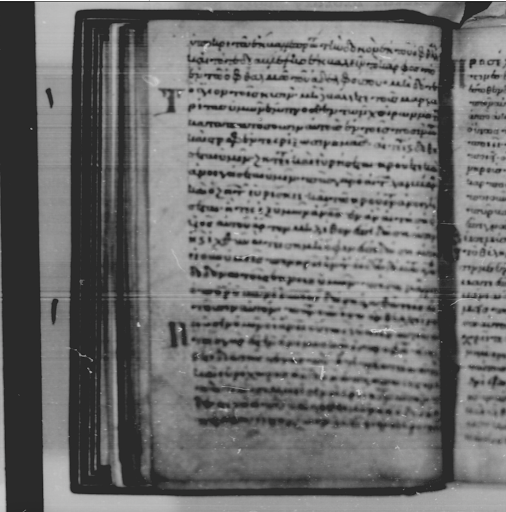
You might be able to decipher the passage. Reading the text on this page is a different matter altogether! By the way, this page contains Matthew 7.5–14.
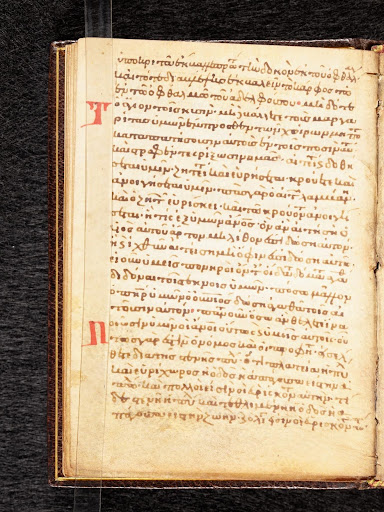
Last year, CSNTM visited the University of California (Riverside) to digitize this manuscript.
Thanks to your support, this same page now looks different:
This is just one of the many thousands of pages of New Testament manuscripts that await digitization so they can become legible and accessible.
CSNTM is currently involved in a large-scale digitization project with the Bodleian Libraries in Oxford, United Kingdom. Numerous New Testament manuscripts remain illegible because of the low quality of the microfilm.
This is the case, for instance, of GA 530, a manuscript of the Gospels dated to the eleventh century. The image below displays the first page of the Gospel of Matthew:
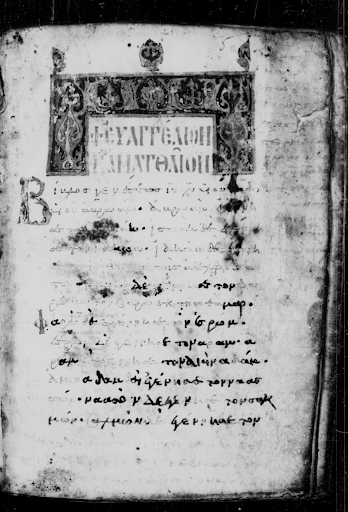
With your help, we are giving this page a new look. Most importantly, we are making this page readable and accessible to scholars studying our New Testament.
Digitizing manuscripts is rewarding, but it is nothing like the personal satisfaction that comes with knowing that I helped to make this possible.
Thousands of pages of New Testament manuscripts still await modern digitization. Because of your continued partnership, manuscripts that are currently difficult or impossible to read are becoming clear, accessible resources for scholars, pastors, students, and future generations.
Thank you for helping preserve the text of the New Testament. Together, we are ensuring that these precious witnesses to Scripture remain available for generations to come.

Denis L. Salgado
CSNTM Lead Research Fellow & Assistant Executive Director