1-100 AD
The Apostolic Age
1-100 AD
The Apostolic Age
The Apostolic Age (1st century)
The story of the collection of twenty-seven books we call the “New Testament” starts with the original documents written by the apostles and their associates. These initial documents are known as the autographs. All compositions comprising the New Testament were produced in the first century in the Greek language. The earliest apostolic texts appear to be the epistle of James and the epistle of Paul to the Galatians, both probably written in the AD 40s. The last composition was the book of Revelation, which was written by John and is usually dated to the AD 90s.
The teachings of the apostles, along with the writings of the prophets in the Hebrew Bible (a.k.a. Old Testament), constitute the foundation of the Christian faith. As the number of followers of Jesus increased and church communities spread across the Roman Empire and beyond, there arose the need to copy the texts that the apostles wrote and circulated. Despite several waves of persecution by the Empire, the growing network of Christ followers labored to transmit to subsequent generations the teachings of Jesus Christ recorded in the written apostolic tradition.
101-300 AD
The Age of the Papyri
101-300 AD
The Age of the Papyri
The Age of the Papyri (2nd–3rd century)
Christian communities most likely began to produce copies of the apostolic texts as early as in the first century when they initially received them. Nonetheless, the earliest direct attestation to New Testament material comes from manuscripts dated to the second and third century. In these first centuries of the church, the copying of the apostolic writings was performed in more informal settings and based on the needs of local congregations.
The earliest manuscripts of the New Testament are known as the New Testament papyri, since texts during this time were copied on a surface derived from the papyrus plant. All New Testament papyri were discovered in Egypt in the late nineteenth century and in the first half of the twentieth century.
100 – 199 AD
The Age of Papyri
100 – 199 AD
The Age of Papyri
Papyrus 52 (P52)
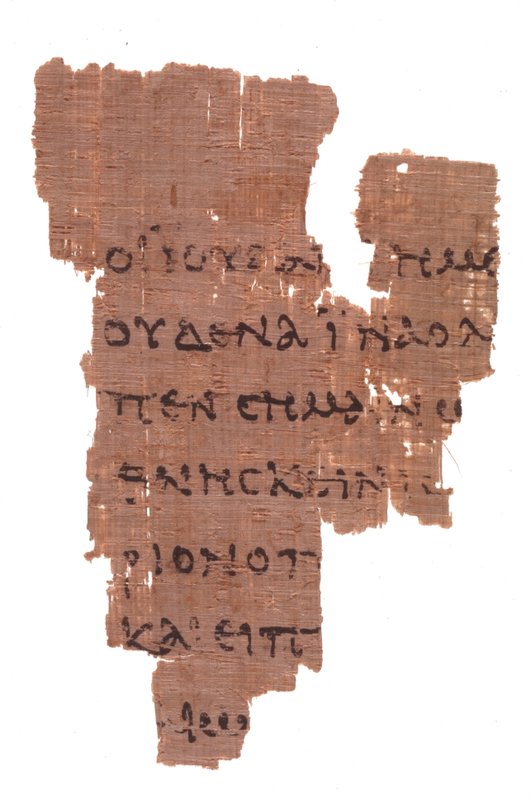
Dated to the second century, P52 is the oldest New Testament manuscript. As shown in this facsimile, the fragment is approximately the size of a credit card and preserves part of the conversation between Jesus and Pontius Pilate in eighteen lines of text as recorded in the Gospel of John: John 18:31–33 (front) and John 18:37–38 (back). Because P52 has the text in this order on both sides of the papyrus, this means the fragment used to belong to a codex (book format). P52 is one of the thousands of papyri discovered in Oxyrhynchus, Egypt, at the end of the nineteenth century.
200 – 250 AD
The Age of Papyri
200 – 250 AD
The Age of Papyri
Papyrus 45, 46, and 47 (P45, P46, P47)
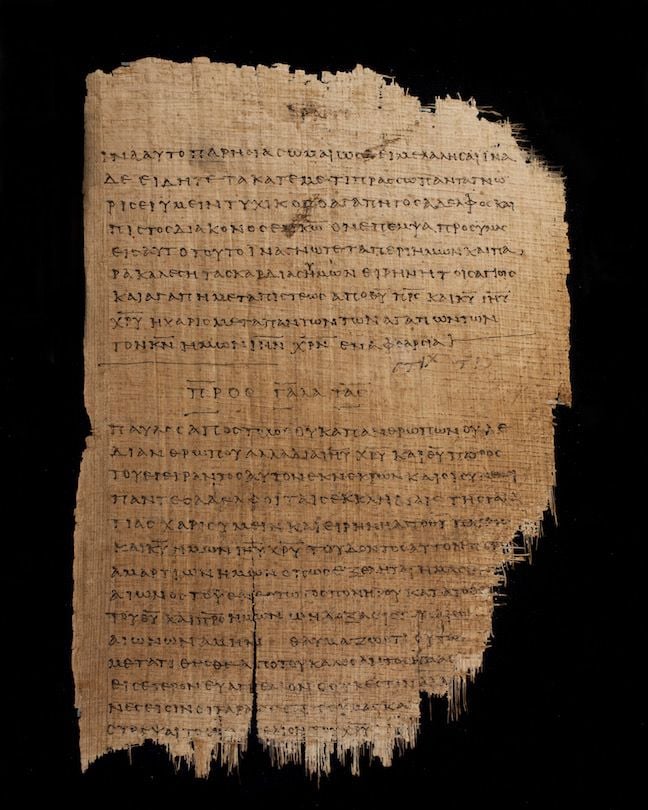
This facsimile combines three different New Testament manuscripts known as P45, P46, and P47, all of which are dated to the third century. P45 is a codex of the four Gospels and Acts with thirty-one leaves extant or still surviving. P46 is a codex containing most letters of Paul in 86 leaves…
250 – 350 AD
The Age of Papyri
250 – 350 AD
The Age of Papyri
Papyrus 66 (P66)
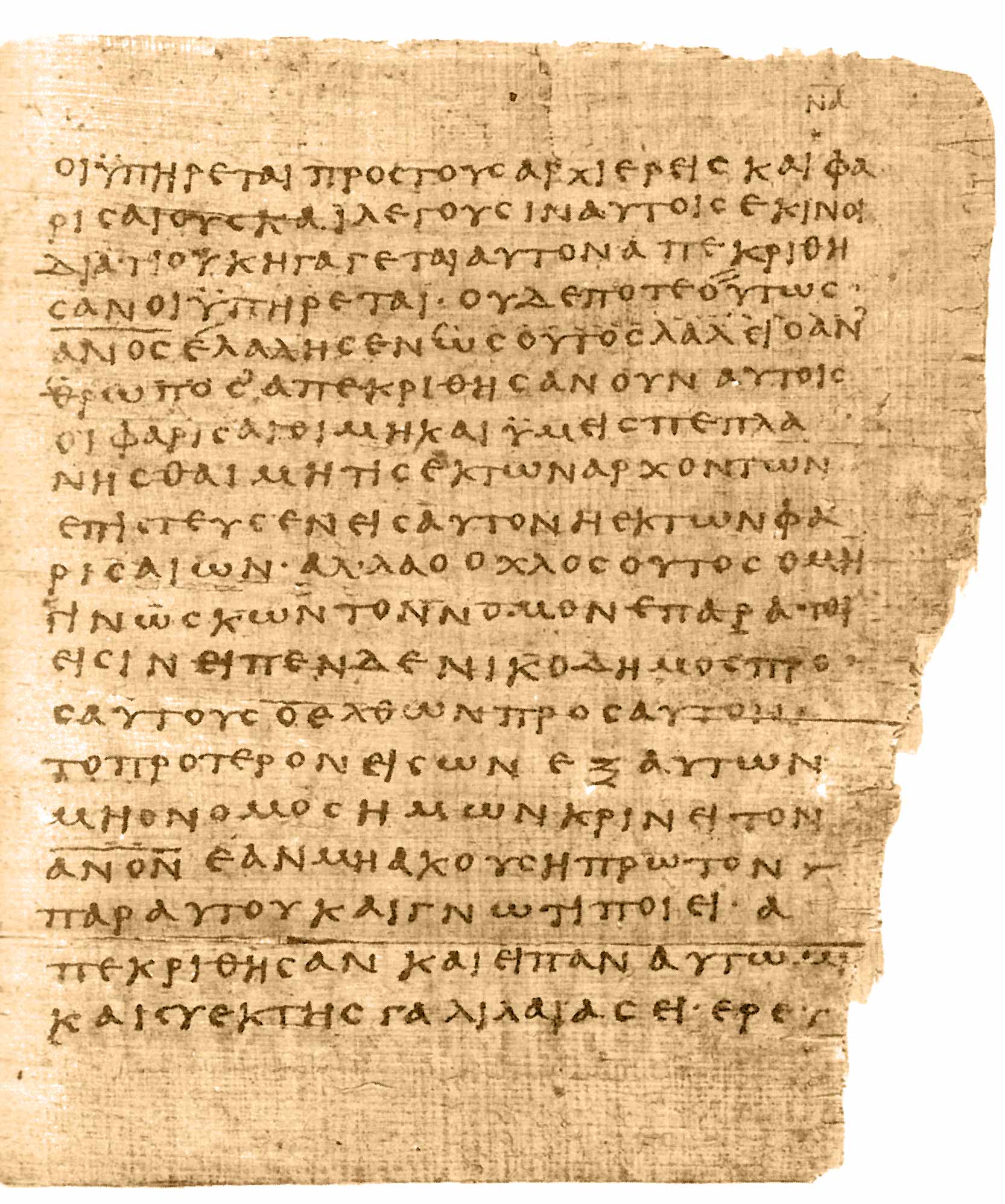
Facsimile of P66, a third/fourth-century codex of the Gospel of John. Although incomplete, the codex preserves most of the Gospel. While 75 leaves are housed in the Martin Bodmer Foundation (Switzerland)…
200 – 399 AD
The Age of Papyri
200 – 399 AD
The Age of Papyri
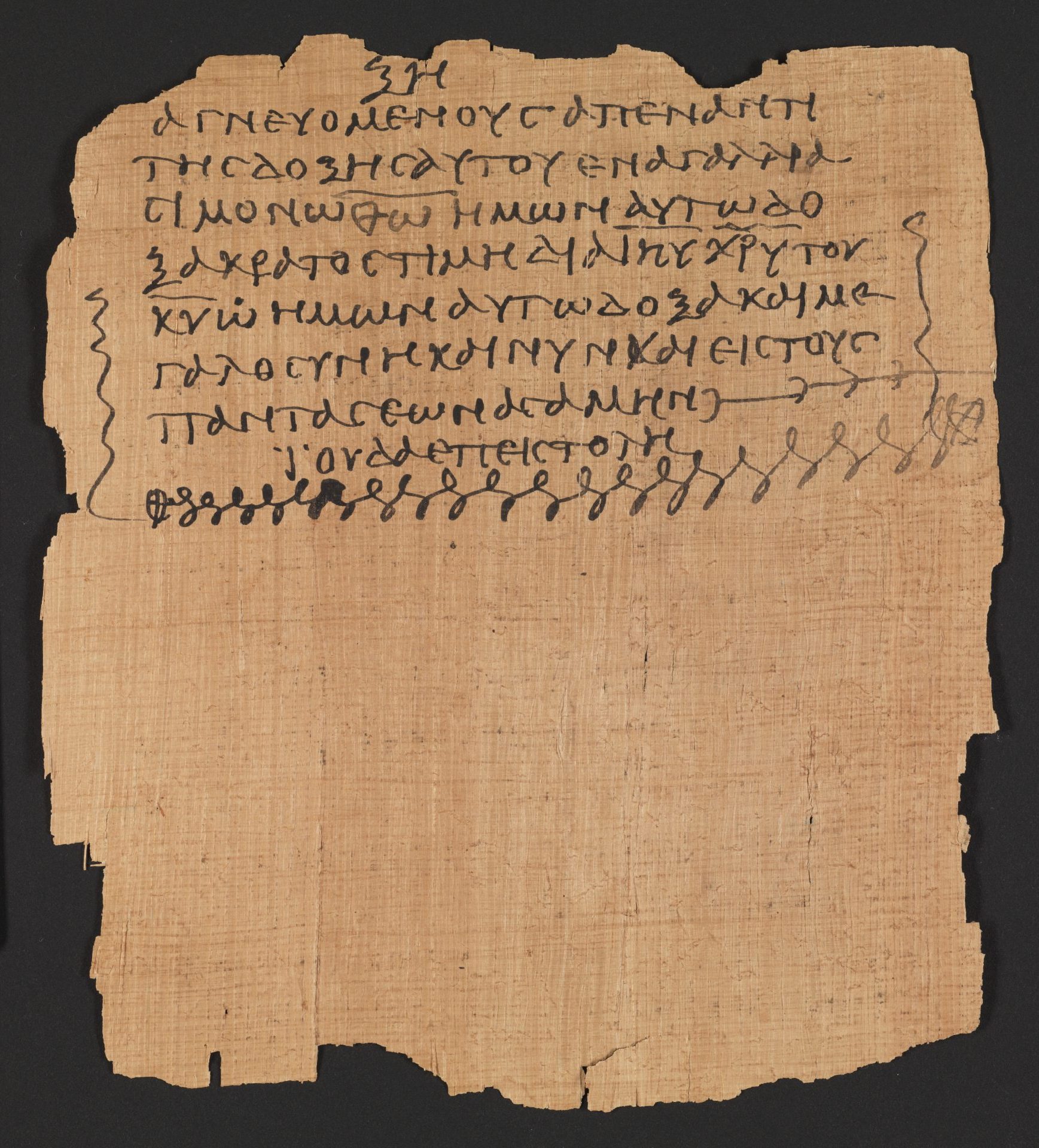
Papyrus 72 (P72)
Facsimile of third/fourth-century manuscript of the Catholic or General Epistles preserving sections of 1 and 2 Peter and Jude. Codex currently exists in two parts. One part is housed at the Vatican Library and…
301-900 AD
The Age of the Majuscules
301-900 AD
The Age of the Majuscules
The Age of the Majuscules (4th–9th century)
The fourth century marks a major historical shift. While the Western Roman Empire declines, the Eastern Roman Empire or Byzantine Empire gains momentum under the leadership of emperor Constantine the Great.
As the first Christian emperor, Constantine makes Christianity the official religion of the empire. This new atmosphere allows the church to flourish and expand in unprecedented ways. Operating with freedom and without the hindrance of persecution, the church gradually matures by deepening its theological understanding, as seen in the formulation of ecumenical creeds. Additionally, Christians develop administrative and religious structures, such as cathedrals and monasteries.
It is also around this time that significant literary shifts occur as well. For many centuries, papyrus was the primary material used to write documents and books. Around the fourth century, parchment, or animal hide, became the preferred writing surface. Moreover, Greek literary handwriting develops into more sophisticated styles typically referred to as majuscule script, characterized by large and formal capital letters.
Thus, New Testament Greek manuscripts produced from the fourth century onwards often exhibit more polished characteristics compared to the rudimentary features observed in most papyri. Codices, some of them rather large, are now produced from parchment. Texts are skillfully executed in the majuscule script. Instead of operating in informal settings, Christian monks trained as scribes copy manuscripts in the formal context of a monastic scriptorium or office. Monasteries, especially those closely connected with the imperial capital of Constantinople, have at their disposal a wealth of resources to craft masterpiece codices, such as Codex Vaticanus, Codex Sinaiticus, and Codex Purpureus Petropolitanus.
300 – 399 AD
The Age of the Majuscules
300 – 399 AD
The Age of the Majuscules
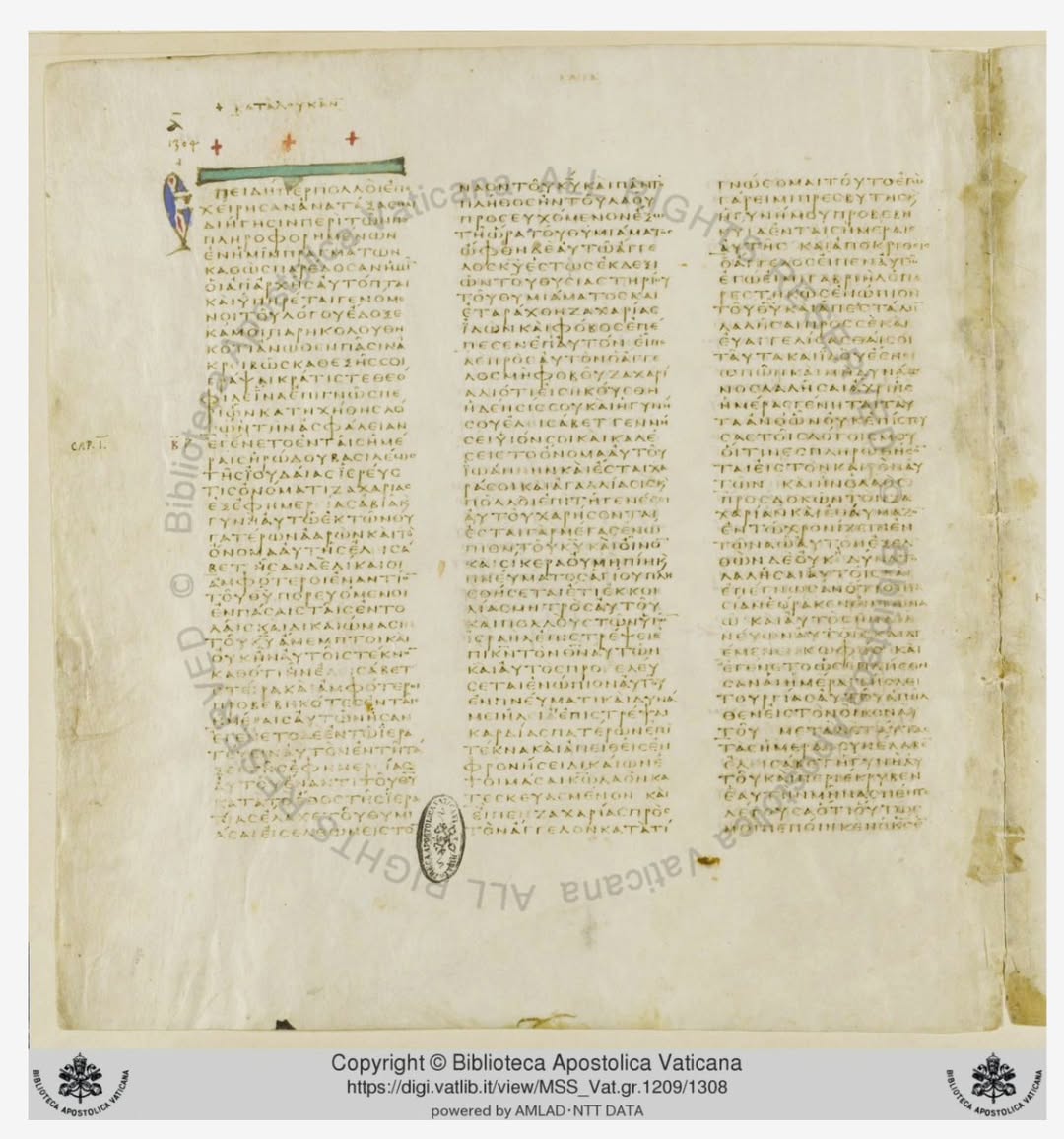
Codex Vaticanus
Facsimile of Codex Vaticanus, also known as Codex B, an important fourth-century majuscule manuscript housed at the Vatican Library. It seems to have been a pandect, or a manuscript of the entire Bible, but is now incomplete: leaves are missing at the beginning of Genesis and some of the Psalms; document breaks off at Hebrews 9.13, thus lacking the Pastorals, Philemon, and Revelation…
300 – 399 AD
The Age of the Majuscules
300 – 399 AD
The Age of the Majuscules
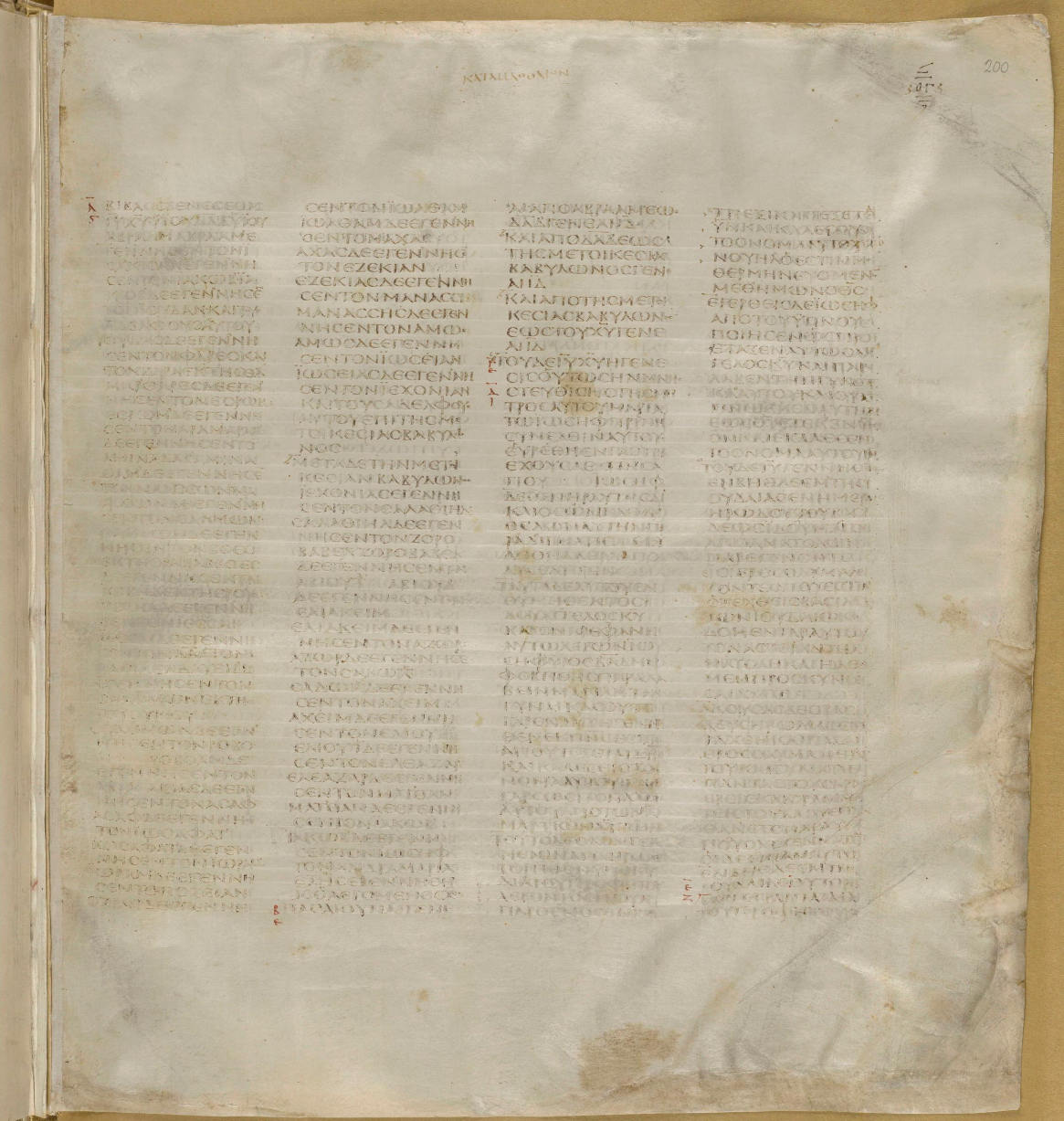
Codex Sinaiticus
Facsimile of Codex Sinaiticus, a fourth-century parchment manuscript of the Old Testament and New Testament in Greek. As such, it is a pandect containing the entire Bible. It also contains non-biblical material after the New Testament: The Epistle of Barnabas and the Shepherd of Hermas. Sinaiticus is the only surviving New Testament manuscript written in four columns.
500 – 599 AD
The Age of the Majuscules
500 – 599 AD
The Age of the Majuscules
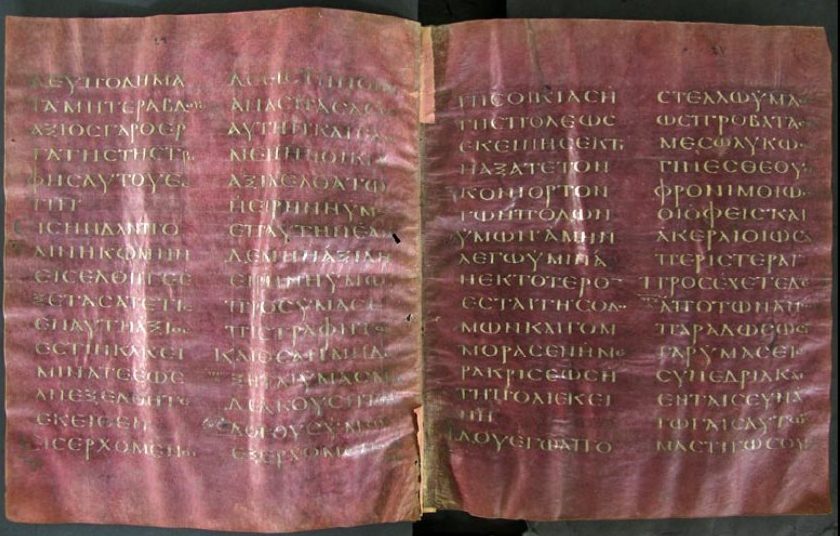
Codex Purpureus Petropolitanus
Codex Purpureus Petropolitanus is a sixth-century deluxe manuscript of the Gospels, possibly produced in Constantinople. The designation “Purpureus” (Latin for “purple”) comes from the fact that the parchment leaves were dyed in purple. The text was written in silver ink, while golden ink was used for the divine names (God, Lord, Jesus Christ, and Holy Spirit). Leaves of the original manuscript are distributed across nine different institutions.
801 – 1500 AD
The Age of the Minuscules
801 – 1500 AD
The Age of the Minuscules
The Age of the Minuscules (9th–15th century)
Around the ninth century, Greek handwriting undergoes another significant change: the minuscule, or smaller and faster cursive script, begins to systematically replace the formal majuscule script. Whereas before the ninth century the cursive script was employed primarily for official documents (such as letters, receipts, legal reports, etc.), now it becomes the standard script for works of literature as well. Whether it is Greek classical literature or Christian writings, all books are copied in the minuscule style. Additionally, it is also around the turn of the first millennium that paper becomes increasingly common in monasteries.
Consequently, virtually all New Testament manuscripts dated to the ninth century or later are written in cursive. This includes regular books of the New Testament, books with commentaries by the Church Fathers, and books designed to be used during services in churches and monasteries. Of the 5,700 New Testament Greek manuscripts in existence today, about 5,200 are written in the minuscule script. The oldest New Testament manuscript in cursive is GA 416, a Gospel book copied in the year 835 by monk Nikolaos. The manuscript came from the Mar Saba monastery in Jerusalem and is known as the Uspenski Gospels. It is currently held at the National Library of Russia in St. Petersburg.
1450 – 1700 AD
The Age of Early Printing
1450 – 1700 AD
The Age of Early Printing
The Age of Early Printing (15th–17th century)
In the middle of the fifteenth century, German goldsmith Johannes Gutenberg combines several discoveries and technologies to design the movable type printing press. The first major book Gutenberg printed on the movable type printing press was the Latin Vulgate Bible, printed in Mainz (Germany) around 1454. This Bible, which is commonly known as the Gutenberg Bible, inaugurated the era of printing.
For the history of the New Testament text, the printing press meant that in the contexts where the press was available, the text was no longer copied manually by scribes. The printing press provided the ability to produce New Testament books in mass and stabilize the text, replicating it with fewer differences.
By the early 1500s, several publishers established themselves across Europe, especially in Italy, Germany, and France. One of these publishers was Johann Froben, whose office was in Basel, Switzerland. He had the ambition to print and publish the first edition of the Greek New Testament. To fulfill his plans, Froben hired the Dutch humanist Desiderius Erasmus to edit the text.
1466 – 1536 AD
The Age of Early Printing
1466 – 1536 AD
The Age of Early Printing
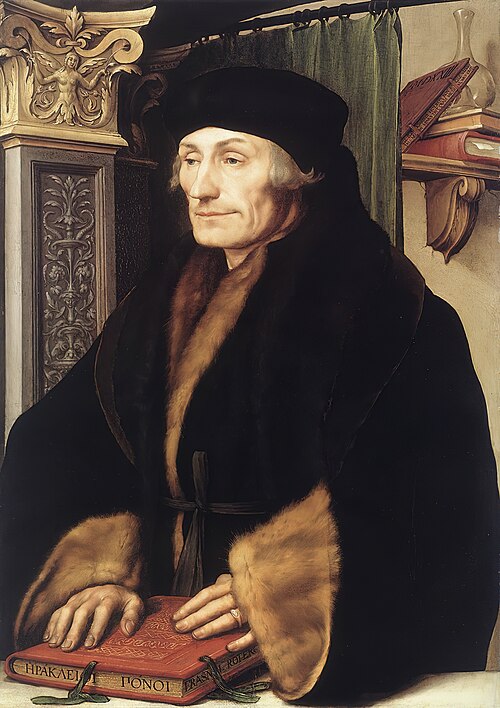
Desiderius Erasmus
Since other publishers in Italy and Spain were producing similar editions, Froben pressured Erasmus to conclude the project in record time. Thus, in 1516, the first edition of the Greek New Testament was published. Unfortunately, however, because of the pressure from the publisher Froben, the text of this first edition was especially deficient: Erasmus was able to use only eight manuscripts available to him in Basel, and all manuscripts were late—most dated to the twelfth and fifteenth century.
It was in this first edition that Erasmus famously left out from the Greek the Trinitarian Formula in 1 John 5:7–8. He argued that the Formula was absent from the Greek manuscripts he consulted, even though it was present in the Latin Vulgate, the version authorized by the Roman Catholic Church.
1524 – 1551 AD
The Age of Early Printing
1524 – 1551 AD
The Age of Early Printing
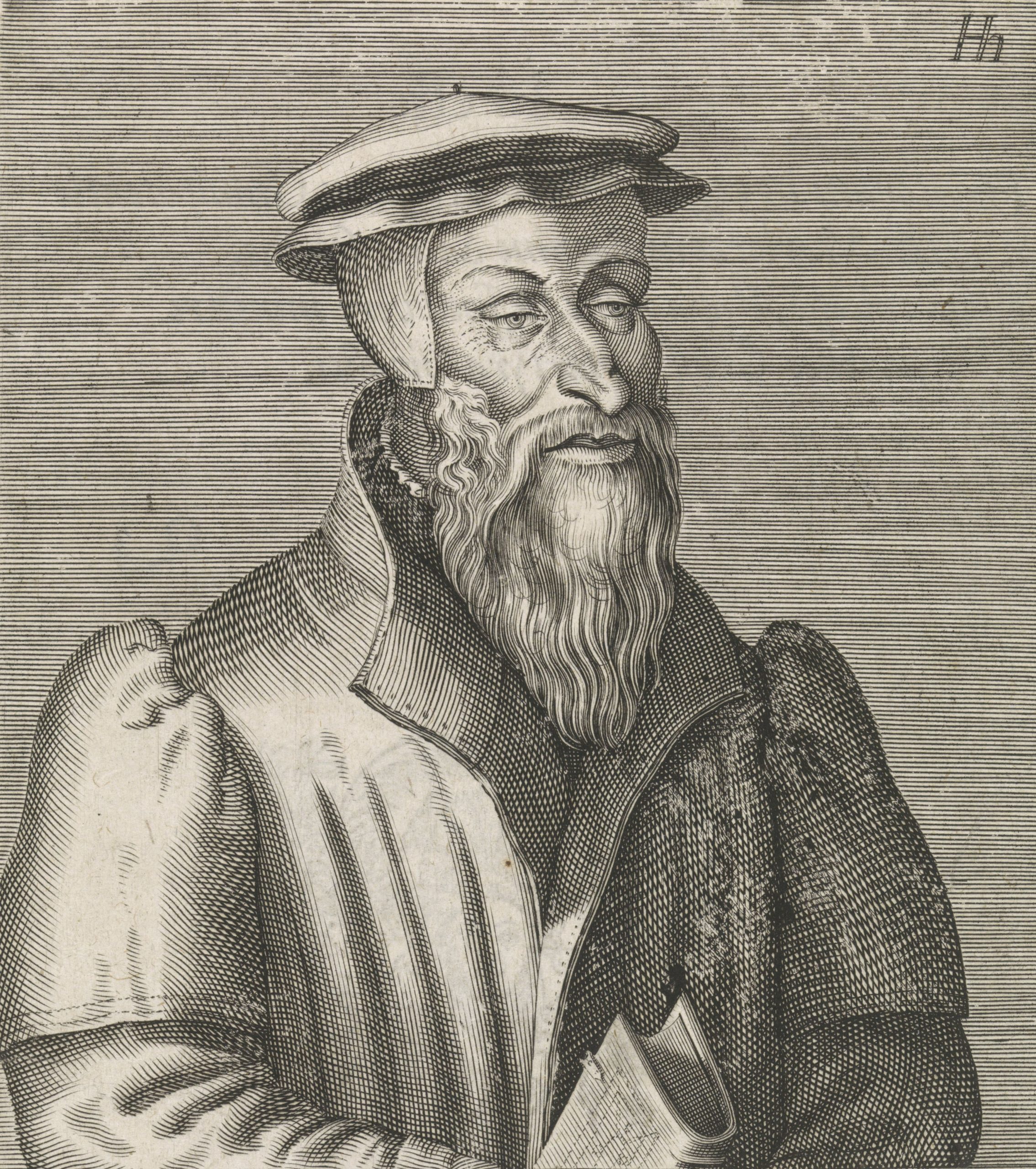
Other Early Printed Greek New Testaments
Other editions of the Greek New Testament appeared in the sixteenth century. In 1524, Wolfius Cephaleus edited a Greek New Testament. The most significant aspect of this edition is that Wolfius removed the Trinitarian Formula from the Greek text. By doing so, he contradicted the edition Erasmus produced in 1522.
In the middle of the century, Robert Estienne or Stephanus (1503–1559)(pictured), son of a Parisian publisher, produced four editions of the Greek New Testament: 1546, 1549, 1550, and 1551. The text printed in these editions rarely deviates from the text edited by Erasmus. However, Stephanus added some innovations. The main one appears in the fourth edition: for the first time, verse numbers accompany the biblical text.
1600 – 1641 AD
The Age of Early Printing
1600 – 1641 AD
The Age of Early Printing
The Textus Receptus
In the first half of the 1600s, the Dutch brothers Bonaventure (1583–1652) and Abraham (1592–1652) Elzevir continued the legacy of Erasmus. They produced three editions of the Greek New Testament: 1624, 1633, and 1641. Like Stephanus, the Elzevirs printed the text of Erasmus. This time, however, the text acquires an elevated status because the Elzevirs write in the preface to the 1633 edition that they are presenting to the reader “the text received by all.” For the first time, therefore, the text of Erasmus becomes known as the Textus Receptus or the Received Text (a.k.a. TR). This Greek text underlies the English New Testament in the King James Bible.
Several editions of the Greek New Testament appeared from 1516 to 1641. Nonetheless, the text being perpetuated was the same one Erasmus produced based on eight late manuscripts. And from now on, this unsatisfactory text is perpetuated with the canonized status of Received Text.
1701 – Present
The Modern Critical Age
1701 – Present
The Modern Critical Age
The Modern Critical Age (18th century–present)
The eighteenth century marks the beginning of the Modern Critical Age in the study of the New Testament text. Many scholars begin to challenge the notion that the Received Text represents the original text of the New Testament. For this reason, they develop methods and principles to analyze manuscripts more systematically.
The first scholar to cast doubt on the existence of a perfect “Received Text” was John Mill (1645–1707) from Oxford. He spent thirty years comparing the New Testament text in approximately 100 manuscripts and considering the text used by the Church Fathers. After three decades of study, Mill finally published his Greek New Testament in 1707. The edition prints the Textus Receptus but lists more than thirty thousand differences in the manuscripts. Mill died two weeks after his Magnum Opus, avoiding criticisms leveled against him and his edition. Many consider John Mill the father of the modern discipline of New Testament Textual Criticism. Scholars from the past have said about Mill and the discipline: “He found the edifice in wood, and left it in marble.”
1693 – 1754 AD
The Modern Critical Age
1693 – 1754 AD
The Modern Critical Age
Johann Jakob Wettstein
Another influential scholar was Johann Jakob Wettstein (1693–1754). He began to organize the evidence of the Greek manuscripts and developed numerous guidelines to help scholars decide which reading is the original. One of his principles was that the Textus Receptus should have no authority. However, he still printed the Textus Receptus in his edition of the Greek New Testament published in 1751–1752. The influence of Wettstein on the discipline was diminished because he was accused of promoting heretical views that denied the deity of Jesus Christ.
1881 AD
The Modern Critical Age
1881 AD
The Modern Critical Age
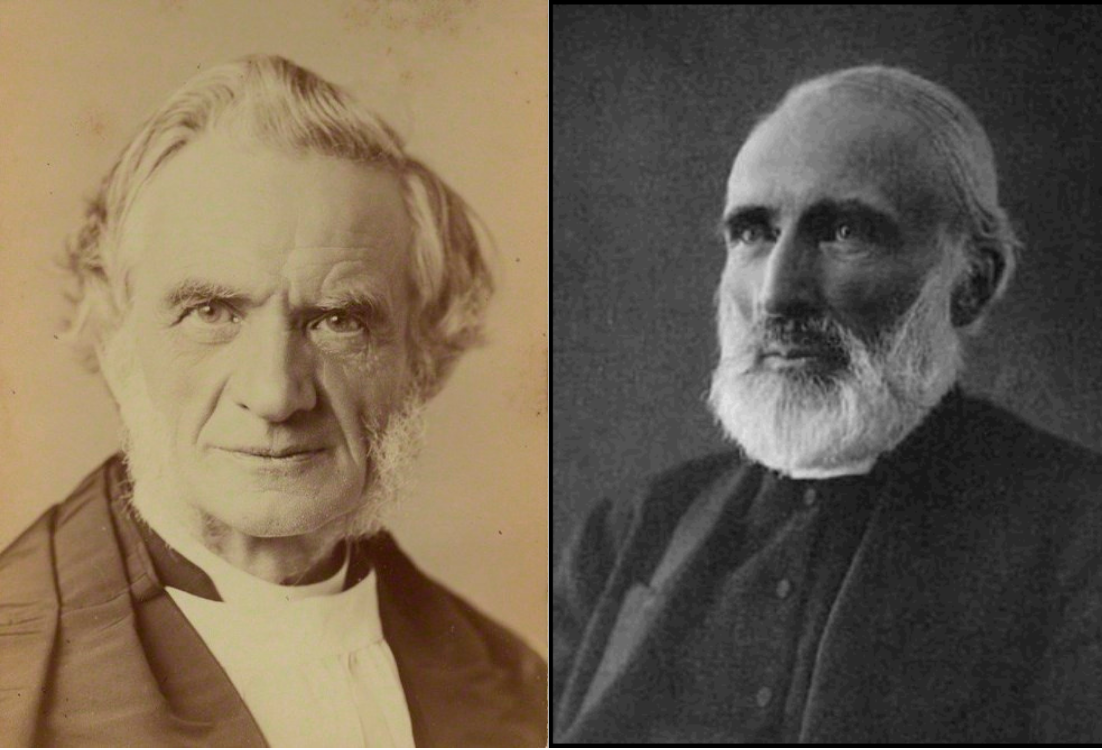
B.F. Wescott and F.J.A. Hort
Throughout the eighteenth and nineteenth centuries, scholars continued to refine the discipline of New Testament Textual Criticism. Most of them, convinced that the Received Text was inadequate, sought to recover the original text of the New Testament. After many attempts to dethrone the Received Text, scholars B.F. Wescott (1825–1901) and F.J.A. Hort (1828–1892) published their edition of the Greek New Testament in 1881. This edition constitutes a turning point in the belief that the Received Text represents the original text.
1898 AD
The Modern Critical Age
1898 AD
The Modern Critical Age
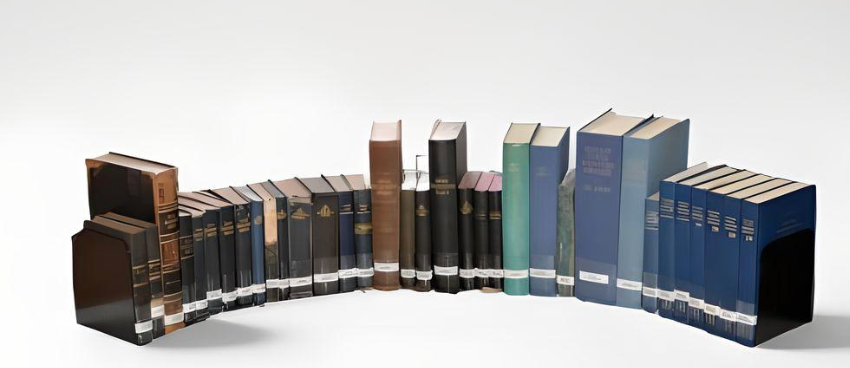
The Nestle-Aland Greek New Testament
In the following decade, Eberhard Nestle (1851–1913) published his first edition of the Greek New Testament. This is the beginning of today’s Nestle-Aland Greek New Testament (NA). Upon Nestle’s death, the publication was handed over to his son, Erwin Nestle (1883–1972). The edition is known as “Nestle-Aland” because in 1952, it was produced in cooperation with Kurt Aland (1915–1994). This is the standard edition of the Greek New Testament used by scholars, Bible translators, seminary professors, and pastors who interact with the New Testament in Greek. Currently, the Nestle-Aland text is in its twenty-eighth edition (NA28).
1959 AD
The Modern Critical Age
1959 AD
The Modern Critical Age
Kurt Aland forms the Institute for New Testament Textual Research (INTF)
Besides editing the edition, Kurt Aland also founded in 1959 the Institute for New Testament Textual Research (INTF) in Münster, Germany. One of the initial tasks of the institute was to create microfilms of numerous manuscripts. INTF also carries out ongoing research into the Greek New Testament, maintains the official catalog of New Testament Greek manuscripts, and edits and publishes the standard critical editions of the Greek New Testament.
2002 – Present
The Modern Critical Age
2002 – Present
The Modern Critical Age
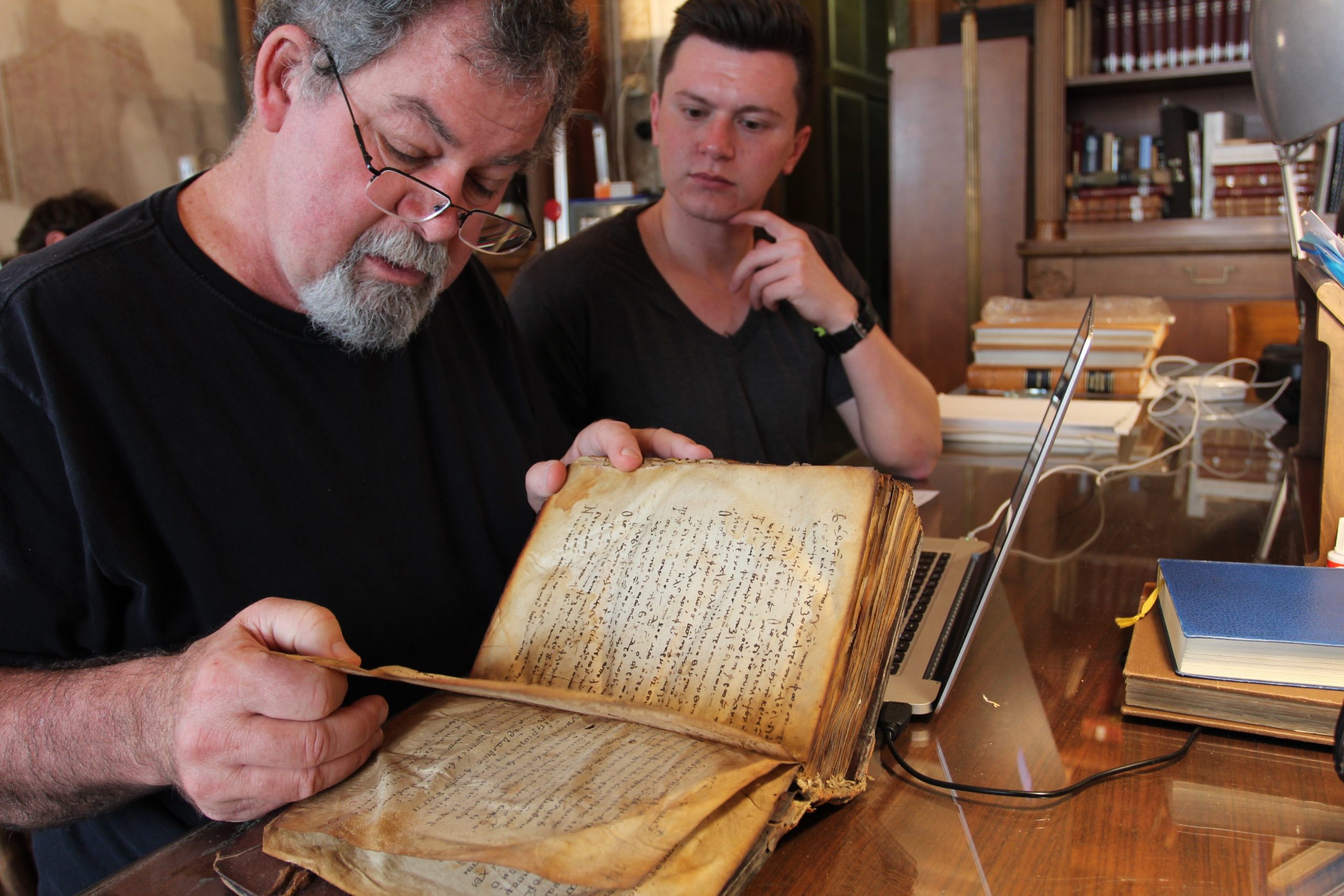
The Center for the Study of New Testament Manuscripts (CSNTM)
In 2002, Daniel B. Wallace founded the Center for the Study of New Testament Manuscripts (CSNTM) to digitize all surviving Greek manuscripts of the New Testament. While microfilm images are helpful, they are often unclear; for this reason, CSNTM has been producing high-resolution photographs of these documents.
The mission began with Wallace digitizing manuscripts using a 4 MP camera mounted on a tripod, where each image took a full 90 seconds to transfer to a computer. Today, the team utilizes the DT Atom Cultural Heritage Digitization Platform. This specially designed system:
- Gently cradles delicate manuscripts to prevent damage.
- Captures images with a 150 MP camera at a rate of 4 images per minute.
- Uses 5000 Kelvin lighting to mimic natural sunlight for full-spectrum exposure.
- Is calibrated to ensure accurate color reproduction.
Beyond standard photography, CSNTM uses this system for multispectral imaging (MSI), a process that reveals text obscured by damage or deliberate erasure. Since 2002, the team has visited hundreds of institutions in more than 50 countries, digitally preserving their manuscripts. They have also discovered almost 60 previously unknown manuscripts that can now be found in the official catalog.
Images are available online on the Digital Manuscript Collection website. Scholars visit the website to study manuscript images as they edit the text that stands behind English translations of the New Testament. Through this work, CSNTM helps ensure that readers of the New Testament today hold in their hands the most accurate text possible.